
This project was part of my Creative Digital Design apprenticeship degree. I was tasked with designing an interactive device for the future. I interpreted this brief as referring to the future of the world as well as design and technology, and I wanted to create something that I believe would benefit society.
The device I wanted to conceptualise would improve the experience of those visiting sites of arts, heritage and culture such as museums and galleries, encouraging higher footfall to these sites, and helping visitors to engage with the pieces they find in these places. The end goal would be for visitors to have a better relationship with art and history, and with the increased footfall to these sites, they would improve financially and therefore would be more protected from funding cuts that could result in their closure.
The device would enable users to learn about the artworks and pieces on show in these places, with the aim of being more informative and engaging than what is currently available in these places. Users can “scan” a piece on display and learn about its history, its creator, its importance and discover similar pieces.
Brand Name
It was important for the brand name to tie into the themes of arts and heritage, so I researched mythology and folklore associated with sight and vision. My initial notes include names such as Helios - the Greek god of sight - and Nazar - the Turkish evil eye talisman. Eventually, I came across the adder stone, a small stone with a naturally occurring hole through it.
Myths from England, Wales and even Russia include the adder stone, but I was drawn to Scottish tales of an de shealladh, meaning “two sight” or “second sight.” People with the second sight were known as Seers, and they were believed to have been able to see fairy worlds or prophecies of the future. One of the most well known of these Seers, the Brahan Seer, was said to have seen his visions by looking through the hole of an adder stone. The stone’s associations with sight and seeing visions, as well as its connection to history and heritage, made it the basis of the inspiration for the brand name and logo.
I merged the two words “adder” and “stone” into a simplified phonetic spelling of Adaston, making the name easier to work with and more memorable. Another notable benefit of the name beginning with an “A” is that it would appear at the top of alphabetical lists.
Brand Logo and Ident
Besides the benefit of names beginning with “A” benefiting from alphabetical ordering, it’s also a letter that I find visually appealing with opportunity for some interesting design choices for the logo. As a typical adder stone is depicted as triangular in shape with a circular hole in the centre, this could be adapted into the letter “A.” Celtic knots also appear triangular, which would acknowledge the influence for the brand name and the device’s purpose.
Using Adobe Photoshop, I created a moodboard of Celtic and medieval styled icons and typography to begin with.
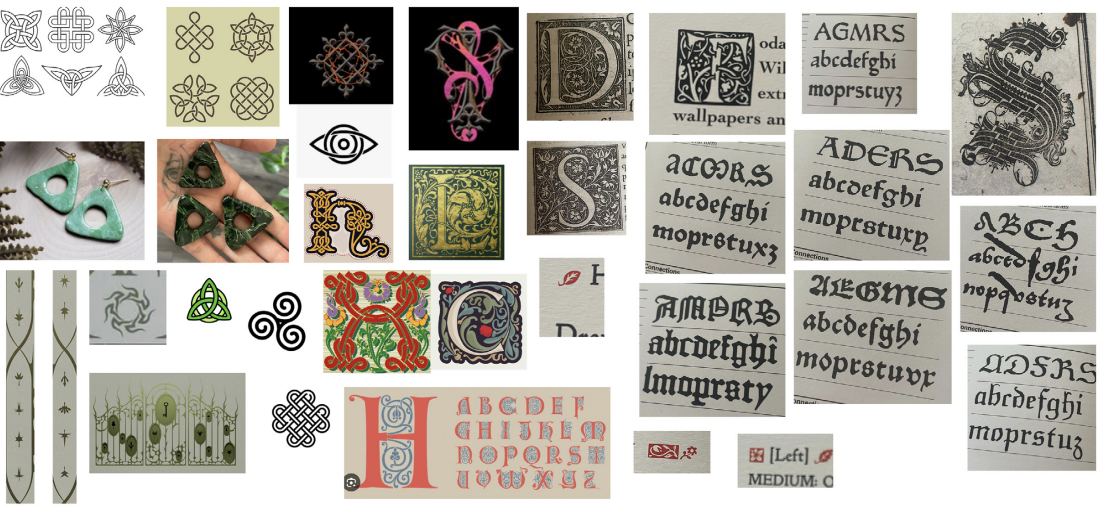
I was instantly drawn to triple spiral symbol, as not only does it contain the triangular “A” shape I was looking for, but I also personally find the spiral to be an interesting symbol with lots of significance. Through the book Signs & Symbols by Miranda Bruce-Mitford, I learned the triple spiral, or Celtic triskele, is an ancient symbol that has been used to symbolise the Triple Goddess and the Holy Trinity.
The spiral reappeared throughout the book, as it has cultural significance throughout many cultures across the world throughout history, mostly relating to religion and spirituality. The triple spiral in particular appears in historic sites, such as the prehistoric passage tombs in Newgrange in the Borne Valley, Ireland.
Spirals continue to be a presence in the arts throughout history up to modernity. They appear in the works of artists such as Leonardo DaVinci, Gustav Klimt, Hilma Af Klint, MC Escher and Robert Smithson.
In both art and mathematics, the spiral is used to demonstrate the golden ratio. The triskele spiral appears on flags across the world, including those of Sicily and the Isle of Man (in the three legged form), and Ust-Orda Buryat Okrug.
Spirals also appear in nature, including cyclones, snail shells, ram horns, sunflowers, pine cones and whirlpools. They show up in large celestial bodies as galaxies, and within our own bodies in the double helix of our DNA. The Tribrachidium was an ancient sea-dwelling fossil animal that had a tri-radial form, just like the triskele.
The symbol’s associations with history, culture, maths, geography, art, science and nature made it a perfect choice for the logo.
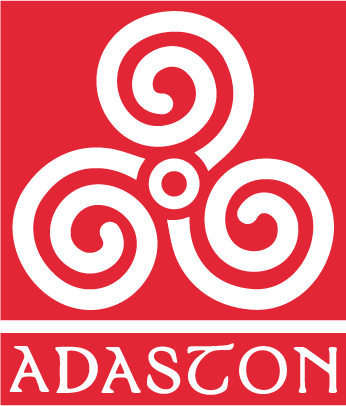
The logo is built around the triskele. I wanted to reinforce two things: the letter “A”, and the adder stone. I added a circle in the centre of the triskele, which I then expanded upon by making the circle separate each of the spirals. Not only does this circle mimic the hole in the letter “A”, but it also can be seen as an eye, returning to the purpose of the device.
For the logo typeface, I wanted it to feel like a heritage text with medieval and Celtic influence. I used the typeface Sinistre by Jules Durand as a starting point, a font inspired by the Book of Kells (which itself features triskeles) and is reminiscent of “Gaelic stone carvings, Celtic calligraphy and Elzevir types.” I altered the text slightly, rounding the edges and lowering the bridge in the “A”.
I wanted to utilise animation to emphasise the “eye” of the logo. I made the centre circle blink and look side to side, before centring itself as it is in the logo. I was really happy with this concept and the final result, as it is simple yet effective, and reinforces the device’s purpose as something to see with, as well as the origin of the brand’s concept of the seeing stone.
The horn used in the audio is a Carnyx, an Iron Age Celtic war trumpet. This tied in nicely with the Celtic origin of the logo and its connection to history. I also added the sound of stones moving as the spirals are revealed, to give the impression these had been carved into rock, similar to the triskele spirals found at the Newgrange site. Lastly, I added the sound of the outdoors with some bird sounds, as some of the sites that Adaston could be used at would be outdoors, reconnecting people to nature and old ways of life.